
Glasscock County Release Paths
“Released” describes the end of one custody event, not always freedom from all custody. A person arrested by the Glasscock County Sheriff may leave a receiving jail on bond, after time served, through a court order, or at the end of a sentence. The person may instead move to another county jail, the Texas Department of Criminal Justice, federal custody, or ICE. A transfer closes one agency’s booking but does not put the person back in the community. The record must name both the departure and the destination.
Glasscock County released inmates therefore leave several records. The physical housing jail creates the closed booking and departure timestamp. A Glasscock court file may contain the bond order, dismissal, judgment, jail credit, revocation, or discharge that supplied legal authority. TDCJ documents a later state-prison transfer, parole, mandatory supervision, and discharge. BOP and ICE maintain separate federal systems. The record creator is the best source for its own event.
- Time served
- Credit satisfies the custody term imposed by the court, subject to any other hold.
- Parole
- Conditional release from prison while the sentence continues under supervision.
- Discharge
- The sentence and its supervision have ended.
- Transfer
- Custody moved to another agency; it is not a community release.
Glasscock County Release Types
The exact disposition code matters. Bond ends confinement while the case remains pending. A personal-recognizance bond is a court-authorized pretrial release, not an acquittal. A dismissal concerns a charge and may not clear every hold. Sentence completion or time served can close a local term, but another warrant may keep the person confined. Parole and mandatory supervision allow a state prisoner to leave a unit while the sentence continues. Even the word “discharge” should be tied to the agency and sentence shown in the source.
| Record wording | Meaning | Next check |
|---|---|---|
| Bond or personal bond | Pretrial custody ended | Glasscock court docket and housing-jail release log |
| Time served | Credited local term ended | Judgment, credit calculation, and hold check |
| Transferred | Another agency took custody | Receiving jail, TDCJ, BOP, or ICE |
| Parole or mandatory supervision | Prison confinement ended conditionally | TDCJ and Parole Division |
| Discharged | Controlling sentence ended | Discharge record and court file |
Glasscock County Release Record Fields
A precise request asks for a closed booking summary, release screen, release log, or booking summary for one arrest. The booking number ties the event to the correct person and prevents a broad search. Ask for the arresting agency, actual housing facility, booking and departure times, release authority, destination, charges recorded at booking, and any associated booking photograph. A phone answer can guide the search, but it is not a certified record.
| Field | What it establishes |
|---|---|
| Booking number and date | The specific custody episode |
| Housing facility | Which jail maintained the physical-custody record |
| Release date and time | When that jail recorded departure |
| Release type or authority | Bond, court order, time served, transfer, or other code |
| Destination or transfer agency | Whether custody continued elsewhere |
| Charges and bond | The booking context, not a final case outcome |
| Booking photograph | An image tied to that booking, if maintained and releasable |
The court and jail dates can differ without conflict. A judge may sign an order before staff finish warrant checks, property processing, or transport. Conversely, a dismissal can follow an earlier bond release. Keep the order date, physical departure timestamp, and database update date separate.
Identity fields deserve the same care. A local booking number, SID, TDCJ number, BOP Register number, A-number, or court cause number is stronger than a name alone. Names can be misspelled, reversed, or shared by unrelated people. Date of birth can help, but it may also be entered incorrectly and should not be republished without need. A sound release note states which identifier joined the jail record to the court case and which private fields were redacted.
Request Glasscock County Release Records
Start with the Glasscock County Sheriff, because the county does not identify a permanent housing jail online. Ask which agency maintains the booking. Then send each custodian a narrow written request under the Texas Public Information Act. Ask for existing records, not an explanation or new calculation. An electronic copy may reduce charges. Texas cost rules allow certain copy, labor, programming, and overhead charges, so request an estimate and narrow the date or record type if needed.
- Provide the full name, date of birth, approximate arrest date, and any case or booking number.
- Ask Glasscock which jail physically housed the person and whether departure was release or transfer.
- Request that jail’s closed booking, release transaction, destination field, and booking photo.
- Request the related order, judgment, or dismissal from the county and district clerk.
- If state or federal custody followed, request that agency’s later status or discharge record separately.
124 Houston Street
Garden City, TX 79739-2110
Phone: 432-354-2361
Fax: 432-354-2325
The Public Information Act requires prompt production within a reasonable time, but it does not promise a fixed production date. If an agency seeks an Attorney General decision to withhold information, statutory ten-business-day and fifteen-business-day steps may apply to that ruling process. They are not universal delivery deadlines.
If the response identifies another county as the custodian, split the request. Ask the host jail for its booking, release, photograph, and destination fields. Ask Glasscock County for its arrest, transfer, transport, and related court records. TDCJ status questions can use the official inmate-information channels, while document requests follow its Public Information Act process. BOP and ICE records use federal FOIA channels. Each request should cover one agency’s existing record rather than asking one office to reconstruct the entire custody history.
Texas Release Record Access Rules
Texas Government Code Chapter 552 governs access to government information, but not every field is public. Confidential identifiers, juvenile records, medical and victim information, security-sensitive material, active-investigation details, and sealed or expunged records can be withheld or redacted. A request should ask the agency to release segregable public fields rather than withhold the entire booking record.
Retention and web visibility are different. The Texas State Library and Archives Commission schedules set minimum periods by record series, while a roster vendor may remove a name much sooner. The custodian must classify the exact item. Expunction under Code of Criminal Procedure Chapter 55A can require covered records to be returned or destroyed. Nondisclosure under Government Code Chapter 411 limits specified criminal-history disclosure but does not operate identically.
Find Released Glasscock County Inmates
No single Glasscock County released inmate search covers every custody path. The county has no current jail and publishes no roster or recent-release feed. Begin with custody attribution, then follow the record to the physical holder. An absent name proves very little until the destination is known.
- Call the sheriff at 432-354-2361 and ask which jail opened the booking.
- Obtain that jail’s booking number and ask whether the event closed as community release or transfer.
- Check VINELink for the participating agency’s custody event, then confirm it with the jail.
- For a felony prison transfer, use the TDCJ Inmate Information Search.
- Ask the Glasscock clerk for the court order or judgment that explains the legal disposition.
- Use BOP or ICE only when federal or immigration custody is supported.
The Released Last 24 Hours and Released Last 72 Hours pages explain the local fallback when no online feed exists. For state sentence calculations, use the Inmate Release Date route.
TDCJ Glasscock Release Lookup
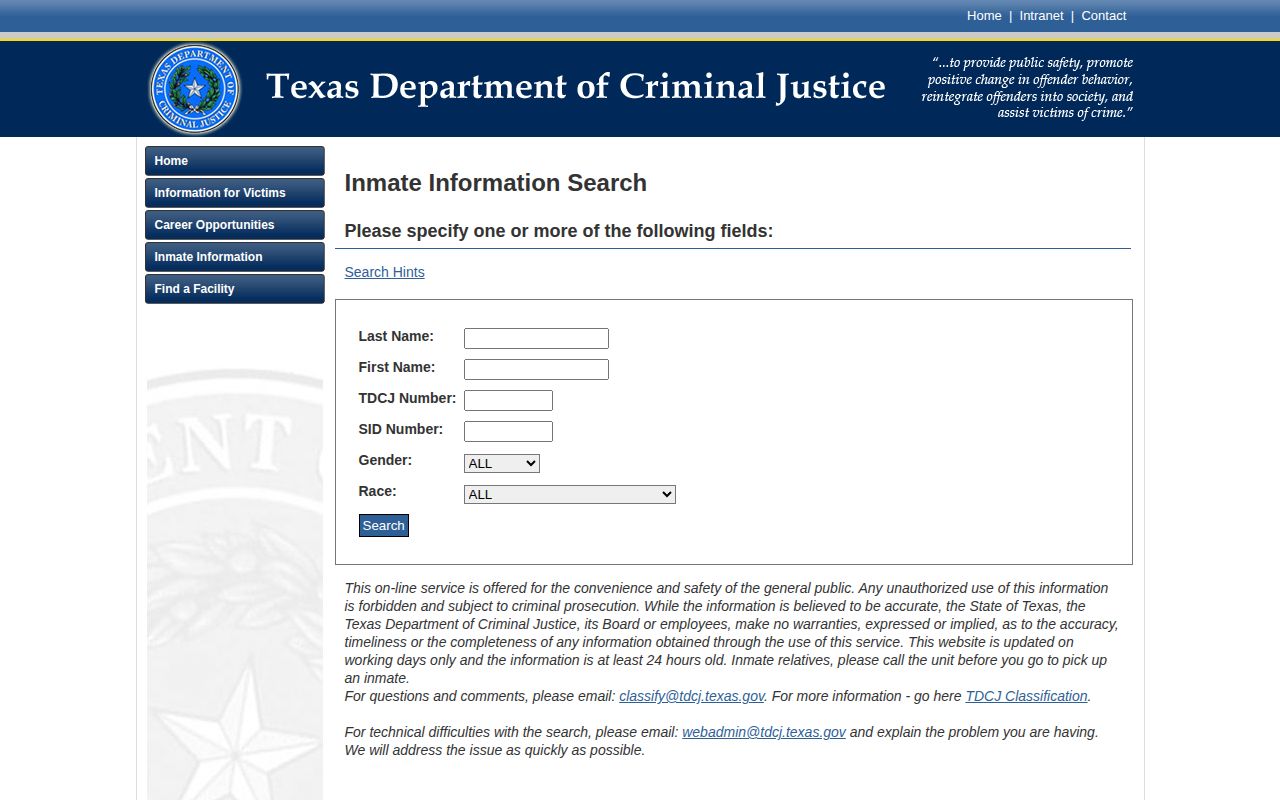
TDCJ applies only after a person enters Texas state custody. It will not prove release from a short Glasscock booking that ended by bond, dismissal, or local time served. A TDCJ or SID number gives the strongest match. Name searches can be narrowed by first name, sex, and race, while the offense county helps connect the result to the correct case.
| Search field | Use |
|---|---|
| Last and first name | Broad match; confirm identity carefully |
| TDCJ number | Direct seven-digit state record match |
| SID number | Texas criminal-justice identity match |
| Sex and race | Optional filters for same-name results |
Projected release, maximum sentence, and parole eligibility are different dates. Scheduled data can change and the live form states that updates occur on working days and remain at least 24 hours old. For a nuanced or historical result, TDCJ asks for the full name, number, and exact birth date through its inmate-information inquiry.
The official TDCJ search form shows the fields used for a state-custody match.
No Glasscock Release Feed
No official Glasscock jail roster, 24-hour list, 72-hour list, sheriff app, or booking-photo gallery was found. The Texas Commission on Jail Standards population reports classify Glasscock as having no jail and can show county prisoners housed elsewhere at an aggregate level. They do not identify an individual release. A receiving jail may have its own roster, but it should be used only after the sheriff identifies that facility for the particular arrest.
When calling, ask whether the person is physically held, released on bond, transferred, delivered to TDCJ, or moved under a federal or immigration hold. Also ask whether the posted event time differs from actual departure. Those questions produce a record path that a missing online name cannot provide.
A host jail’s public roster may show only active custody. If a name disappears, capture the facility, booking number, and retrieval time, then ask for the closed transaction. Do not assume the roster’s visible window equals the legal retention period. Contracts, web vendors, and housing destinations can change, so a prior arrest at one receiving jail does not establish where a later Glasscock arrest was booked.
Glasscock Post-Release Supervision
Parole is decided by the Texas Board of Pardons and Paroles and supervised by the TDCJ Parole Division. The current county cross-reference maps Glasscock to the Big Spring District Parole Office in Region V. Probation, called community supervision in Texas, is ordered by a court and administered through a Community Supervision and Corrections Department. The current directory groups Glasscock, Howard, and Martin counties, with Howard County as the main contact.
Search TDCJ first for a parole or mandatory-supervision record, then confirm the assigned office. For probation, read the judgment and docket, then contact the named department. The Parole / Probation page separates these systems and explains discharge, violations, and office verification.
Glasscock Release Alerts and Transfers
The official sheriff page points residents to Texas VINELink. Search one person by exact name or identifier, read the supplying agency and event, and register for an available phone, text, or email notification. A released or out-of-custody event is a notification record, not a certified discharge. It can lag and should be confirmed with the housing jail. The VINELink Release Check covers the registration sequence and four-digit telephone PIN.
For federal sentences, the BOP Inmate Locator can display “Released” and a date. It does not cover ordinary county bookings or every federal pretrial detainee. ICE’s Online Detainee Locator System is mainly a current locator. A county notation that says “released to ICE” records a transfer, not community release. Historical BOP or ICE records may require FOIA requests.
Match Glasscock Records to Custody
Use each system for the event it owns. A current locator answers where someone may be held now. A release log answers when one booking closed. A court order explains the legal authority, while a discharge record answers whether a sentence ended.
| System | Best use | Key limit |
|---|---|---|
| Glasscock Sheriff | Identify the housing jail and handoff | No local online roster |
| Receiving jail | Physical booking and release time | Facility varies by case |
| TDCJ | State custody, projections, parole, discharge | No short county-only booking |
| County court file | Bond, dismissal, judgment, sentence | May omit door-release time |
| BOP or ICE | Supported federal custody path | Not a county release database |
Glasscock Custody System Directory
The Glasscock County Sheriff’s Office is the starting point, not a current jail. The Contract or Receiving County Jail holds the physical booking when another county accepts the person. Texas Department of Criminal Justice applies after state intake. The Federal Bureau of Prisons and ICE Detention Network apply only to supported federal paths.
Glasscock Release Orders at the Clerk
Glasscock publishes a combined County and District Clerk contact, which is especially useful when no jail trail appears online. Ask staff to identify the court and case number before requesting the docket, bond order, judgment, dismissal, or discharge. Felony matters may involve the 118th District Court, while county-level or justice matters follow other routes. The clerk’s iDocMarket link is for property records and should not be treated as a criminal docket.
A court record explains why release was authorized, but the receiving jail’s closed booking gives the physical departure time. Pair the two. If an appeal, warrant, or another charge changed the outcome, obtain that record rather than assuming the first order cleared every custody barrier.
Is the 1894 Glasscock Jail Active?
No. Search results can surface the stone courthouse and jail built in 1894, but the Texas Historical Commission record identifies it as a former courthouse and jail and gives its service period as 1894 through 1909. It is a historic site, not today’s release desk. Current custody questions belong with the sheriff and the case-specific receiving jail.
Track Every Glasscock Custody Handoff
The arresting county, housing county, sentencing court, and later corrections agency can all differ. Build a chronology with the arrest date, receiving-jail booking, court order, physical departure, transfer destination, and record retrieval date. For state custody, add parole eligibility, Board decision, projected release, actual release, and maximum sentence dates. Each milestone answers a different question.
When sources disagree, ask each creator about its own event. The court owns the order, the jail owns departure, TDCJ owns state processing, the Board owns its vote, and Parole Division owns supervision. A defensible conclusion states the scope: the named booking closed under a stated code, and follow-on searches did or did not show another custody system on the recorded retrieval date.
Use careful language in the final chronology. “The host jail recorded departure on this date under this disposition” is narrower and more reliable than saying the person was free or every charge ended. If TDCJ, BOP, or ICE checks were made, note their retrieval dates and exact results. Dynamic records change. A later correction should replace the older claim while preserving which agency supplied the update.