
TDCJ Release Paths
TDCJ uses several distinct outcomes. Parole is conditional community release authorized by the Texas Board of Pardons and Paroles. Mandatory supervision is a statutory release path with its own eligibility and Board review rules. Discharge means the state custody or supervision obligation has ended. Transfer between TDCJ units is not release.
The TDCJ Inmate Information Search is the primary statewide lookup.
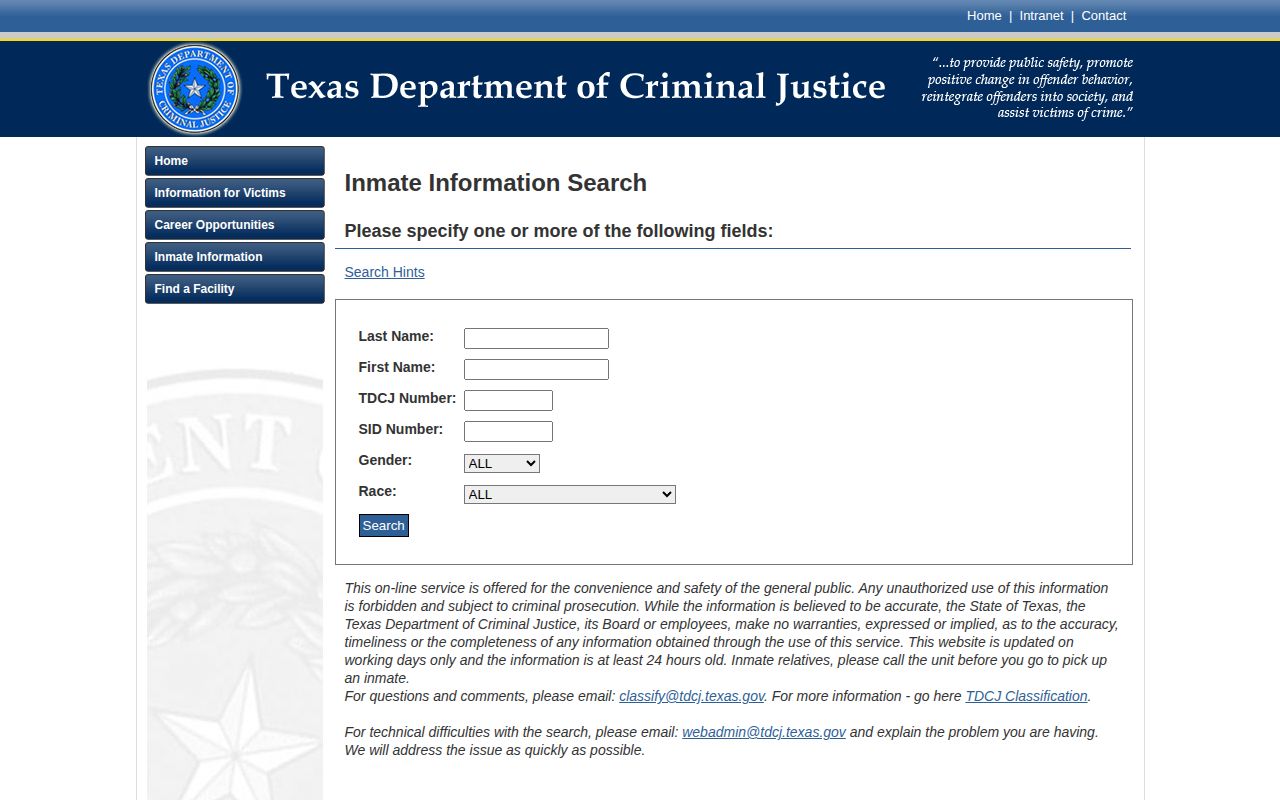
The captured official form shows the name and number search routes. Results can show current location and sentence-related dates, but a projected or eligibility date alone does not prove physical release.
| Answer | Next record |
|---|---|
| Community release | Closed booking and release record |
| Another county | Receiving jail roster and booking record |
| TDCJ transfer | TDCJ offender search after intake |
| Federal or ICE transfer | Correct federal locator and case record |
Confirm TDCJ Release Status
Use the seven-digit TDCJ number whenever possible. A SID number, exact name, sex, and race can also narrow a search. The Glasscock County release search helps reconcile the earlier county case.
- Search the official TDCJ portal by TDCJ or SID number, or by exact name.
- Match date of birth, conviction county, and identifiers.
- Read current location, status, projected release, and parole fields in context.
- Use the TDCJ status contact route when scheduled information is unclear.
- For parole, confirm active supervision through the current Parole Division directory.
TDCJ Records and Contact
TDCJ publishes current search, telephone, and e-mail routes on its offender-information pages. Those live contacts should be used instead of copying a number that can change. The free e-mail route requests the full name and TDCJ number. If unknown, it accepts exact birth data or approximate age plus conviction county.
Texas Department of Criminal JusticeStatewide system; no unit in Glasscock County
Inmate Information by E-mail
Current telephone routes
Request existing fields, not a new report. Useful terms are full name, date of birth, arrest date, booking number, housing facility, admission and departure times, release type or authority, transfer destination, and the booking photograph. If another county held the person, send that jail the booking portion while asking Glasscock for its arrest and transport records.
No TDCJ Glasscock Unit
No state prison was identified in Glasscock County. A sentenced person reaches TDCJ through intake elsewhere. The county judgment and receiving-jail transfer record explain the handoff; the TDCJ record begins after state receipt. Unit custody and Parole Division supervision answer different phases.
A housed-elsewhere report is periodic. It cannot identify one person’s current location or prove an individual release. Use its date and limits. Then obtain a case-specific answer from the sheriff and receiving custodian.
The source page above shows the statewide reporting context. It reinforces that a county of arrest and a county of confinement may differ.
Historic Jail Is Not TDCJ
The 1894 courthouse and jail record describes former county use ending in 1909. It is not a TDCJ unit, intake center, parole office, or discharge desk.
A state search should stay with TDCJ. Historical local search results cannot identify the prison that received a Glasscock County defendant.
Track Each Glasscock Handoff
Custody attribution is the central record problem. The arresting sheriff, physical housing jail, sentencing court, and later state or federal agency can all be different. Write down each agency, identifier, event time, and source date. A sound custody timeline might read: Glasscock arrest, receiving-county booking, receiving-jail departure, then TDCJ intake. Only the evidence after the last step establishes whether the person reached the community.
VINELink may show an agency-fed custody event, but it is not a certified release record. Court files add legal cause. The combined County and District Clerk can help locate a bond order, dismissal, judgment, sentence, or discharge when the online jail trail ends.
- Release
- Departure to the community under the stated legal authority.
- Transfer
- Movement from one custodian to another while detention continues.
- Discharge
- Completion of the custody or supervision obligation shown by the responsible agency.
- Detainer
- A request or authority that may keep custody in place for another agency.
Request Glasscock Release Proof
Texas Government Code Chapter 552 governs written public-information requests. Ask for an electronic copy and request a cost estimate. Glasscock publishes no special release-record fee schedule, so no fixed amount should be assumed. The agency may redact confidential data or cite an exception while releasing separable public fields.
The maintaining custodian matters more than the arrest label. A narrow request reduces delay and helps distinguish Glasscock’s own transport record from the receiving jail’s release log. Keep the response, request date, and any clarification in the same file as the court disposition.
Note: Confirm the final agency and event before saying a person left custody.
Read TDCJ Release Fields
TDCJ fields answer different questions. Current unit or location describes custody when the data was updated. Projected Release Date is an administrative estimate based on the sentence, controlling law, credits, and case facts. Maximum Sentence Date is the calculated endpoint. Parole Eligibility Date marks the first point at which parole may be considered. It is not an approval or a promise of release.
The TDCJ definitions should control how those labels are read. Parole means conditional release under supervision after a Board decision. Mandatory supervision is a separate statutory release form. Discharge means the state sentence and any TDCJ supervision reflected by that record have ended. A unit transfer, medical movement, or county writ does not equal release.
| TDCJ field | Safe reading |
|---|---|
| Projected Release Date | Changeable administrative projection |
| Parole Eligibility Date | First possible consideration point |
| Maximum Sentence Date | Calculated sentence endpoint |
| Parole or supervision status | Community supervision phase to confirm with Parole Division |
| Discharged | No remaining TDCJ custody or supervision shown |
Match Glasscock TDCJ Identity
Start with the seven-digit TDCJ number because names can repeat and change. The State Identification number is another strong key. When neither is known, search by exact name and use sex and race filters, then compare date of birth, conviction county, offense, and sentence. Do not attach a Glasscock court case to a state result merely because the names look alike.
Dates must be reconciled across systems. The receiving county’s departure time can precede TDCJ intake because transport takes time and each system posts its own event. A county notation saying “released to TDCJ” means transfer into state custody. Confirm state receipt before describing the handoff. Later, a projected date can move because of a detainer, disciplinary change, new sentence, jail-credit correction, parole decision, program requirement, or recalculation.
When the online record is ambiguous, use TDCJ’s inmate-information e-mail route. Supply the full name and TDCJ number. If the number is unknown, provide exact birth data or approximate age plus conviction county, with the person’s name in the subject. The route may return offenses, counties, courts, and projected date. It does not provide photographs or Social Security numbers.
Request TDCJ Release Records
A status question and a document request use different channels. The search, telephone, and e-mail routes handle current offender information. A written Texas Public Information Act request is appropriate for releasable TDCJ records not supplied there. Identify the TDCJ number, record type, unit or division, and date range. Request existing documents rather than asking staff to calculate a new legal answer.
For the Glasscock-to-state handoff, keep three records together: the signed county judgment, the housing jail’s transfer or release log, and the TDCJ intake and later status. The judgment shows sentence and credit. The jail log shows departure from the local custodian. TDCJ proves state receipt and later parole, mandatory-supervision, or discharge status.
If parole appears, use the current Parole Division directory to identify the supervising office. The research maps Glasscock to Big Spring in Region V, but assignments should still be checked against the current record. A favorable Board vote alone is not proof of physical release. Processing, plan approval, a detainer, or required program placement can remain.