
Glasscock Release Alerts Explained
Texas VINE uses VINELink as its public custody-search and notification entry point. The Glasscock County Sheriff's official page links visitors to VINELink, which makes the service the county's documented online route for custody-status checks. The agency that holds or books the person supplies the underlying event. VINELink then displays that agency-fed status and offers notification choices when they are available.
Coverage is not the same as a county roster. Glasscock is listed by the Texas Commission on Jail Standards as having no jail, so an arrest may lead to booking or housing in a receiving county. Search results must be read by supplying agency. A status such as released or out of custody means that agency reported a departure. Transfer, escape, death, and release are separate events. None should be substituted for another.
The VINELink state-selection screen is the correct starting point for Texas custody records.
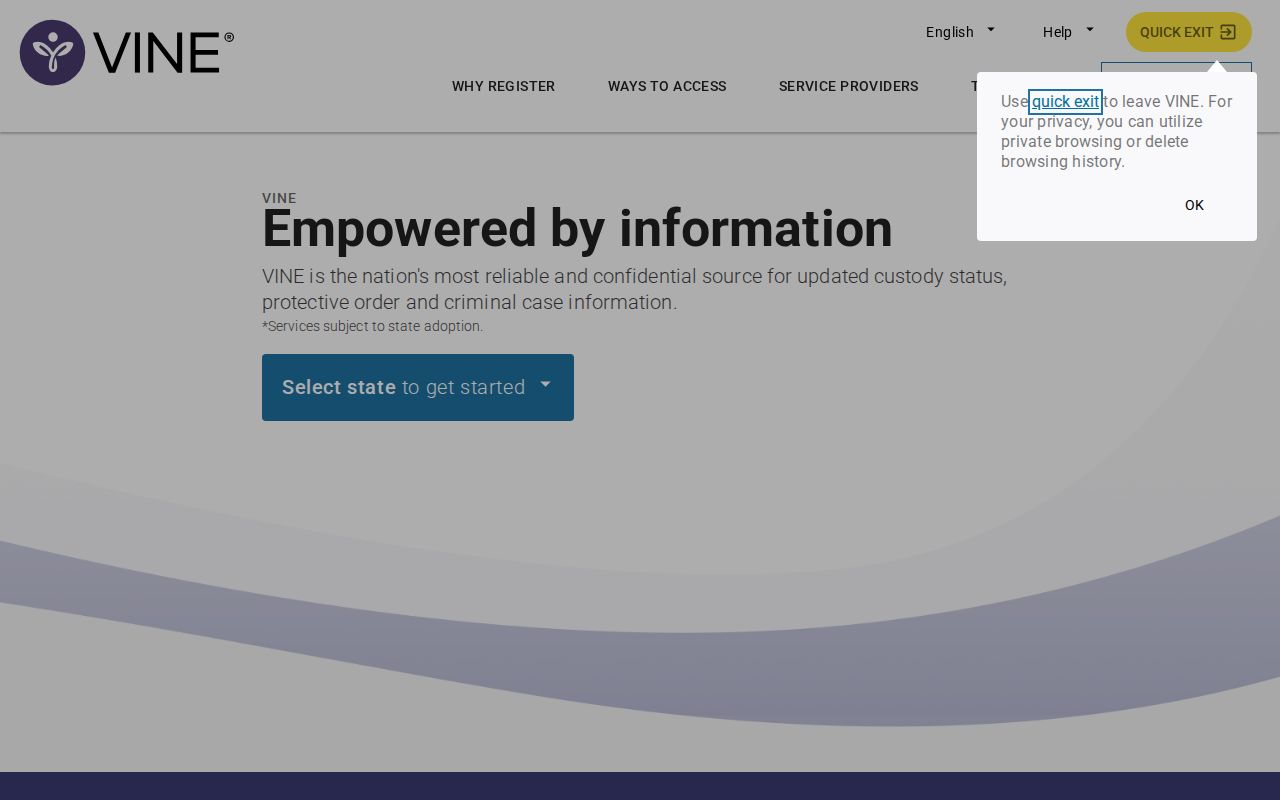
The captured screen shows the national entry route. Select Texas before searching so results come from the correct state network.
Search One Glasscock Release
Start with the person's exact legal name and an agency identifier when one is known. A local booking number, SID number, or offender ID is stronger than a name alone. Names may be misspelled, reversed, or shared by several people. The event also may be listed under the receiving jail rather than under Glasscock County.
- Open VINELink and choose Texas.
- Select the custody or offender search and enter the exact name or identifier.
- Compare every match by available identity fields. Do not choose solely by a similar name.
- Open the matching record and note the reporting agency, custody label, event date, and record identifier.
- Call the reporting jail or the Glasscock County Sheriff at 432-354-2361 to confirm what the event means.
If several matches remain, ask the sheriff which jail physically housed the person and for the booking number. Then repeat the search using that fact. The broader Glasscock County released-inmate search explains how court and agency records can close gaps left by a notification result.
Glasscock Release Result Fields
A VINELink record should be read as a dated agency report. Save the time of the check because dynamic status can change. These fields answer different questions:
| Field | What it establishes |
|---|---|
| Name or identifier | Helps connect the result to one person, but must be checked against the booking or case. |
| Supplying agency | Identifies the jail or system that reported the event and should confirm it. |
| Custody status | Shows the agency's current label, such as in custody, released, or out of custody. |
| Event and date | Dates the reported custody change. It may not equal the physical door-release time. |
| Location | May identify a facility, but a move can occur before the public record refreshes. |
VINELink does not replace a bond order, judgment, dismissal, jail release log, or TDCJ discharge record. A court file explains legal authority. The housing jail records physical departure. TDCJ controls state-prison status. Keep those roles distinct.
Register Glasscock Release Notifications
Registration attaches an alert to the correct person and agency record. Offered delivery methods and events can vary by agency, so use the choices displayed in the live interface. Select release or custody change only after confirming the identity.
- Open the matching person and agency record.
- Select the notification option and choose an available event.
- Choose phone, text, email, or another offered delivery route.
- Enter and verify the destination.
- Create the four-digit PIN if the telephone flow requests one.
- Complete the confirmation message or call and retain the registration details.
The PIN acknowledges telephone notices and can be needed to modify them. It is not a jail account credential. Automated calls may repeat when receipt is not acknowledged. Update or cancel a registration through the saved details when circumstances change.
Confirm Glasscock Release Status
Notifications can lag. A missing result may reflect spelling, update timing, agency participation, another custody system, or a protected record. It does not prove release. First call Glasscock County to identify the physical jail. Then ask that custodian whether the booking closed as bond, time served, court release, transfer, or another disposition.
Use the TDCJ Inmate Information Search for a person received into Texas state custody. Use the BOP Inmate Locator for federal prisoners and the ICE detainee locator for immigration custody. VINELink is not a national all-jails registry, a court disposition database, or an emergency service.
For a record-grade result, request the closed booking and release transaction from the housing jail under the Texas Public Information Act. Match its booking number and departure event to the VINELink notice. A court order can then explain the legal basis, while the jail record supplies the custody timestamp.
Build a short chronology when the records do not seem to agree. Keep the arrest and booking date, court-order date, physical departure time, VINELink event time, and retrieval time in separate columns. A notice received after the jail departure is not necessarily wrong. The notification service depends on an agency update, and the court may sign an order before another hold clears. Ask each source about its own event instead of forcing all dates to match.
The same rule applies to state custody. A Glasscock booking can close as a transfer to TDCJ, followed by state intake and a later parole or discharge event. VINELink may report one step while TDCJ records another. Obtain the county transfer destination and timestamp, then use the TDCJ or SID number to confirm state receipt. Only a later state release event establishes departure from that system.
Why Glasscock Uses VINELink
Glasscock County's victim-notification layer is unusually direct and spare. Its sheriff page sends visitors to VINELink but publishes no local roster, recent-release feed, or named permanent housing jail. That official referral validates VINE as a local online check. It also defines the limit: the unnamed receiving jail still owns the detailed booking and release record.
The practical chain is short. Record the VINELink result, call Sheriff Keith Burnett's office to identify the receiving jail, and confirm the event with that jail. If the custody trail continues into TDCJ, federal, or immigration custody, switch to the agency-specific locator. This preserves the difference between a Glasscock arrest, a host-jail booking, and a true return to the community.
For safety concerns, do not wait on an electronic alert. Texas VINE materials direct users to call 911 in an emergency. Notification timing rests on agency data and is never a promise of immediate delivery.
Registry data also has a narrow role. The Texas Public Sex Offender Registry concerns people with a current legal duty to register. It is not a general list of released inmates. A person can be released with no registry record because many offenses create no registration duty. A registry result can show a person in the community, but it cannot supply the county jail's physical release time.
For an old Glasscock event, the online notice may no longer be enough. Request the closed booking from the receiving jail and the bond order, judgment, dismissal, or discharge from the combined County and District Clerk. If state custody followed, ask TDCJ for incarceration history. This layered record preserves both the reason custody ended and the agency that actually released or transferred the person.
Telephone confirmation should be recorded with care. Note the office, date, number called, booking identifier, and the exact event term used by staff. Ask whether the answer describes a system-posting time or the moment of physical departure. If the clerk can only give general information, follow with a written records request. A certified or agency-produced record carries more weight than a memory of a call.
Do not confuse a closed booking with a closed criminal case. Bond can end jail custody while prosecution continues. A dismissal may come after release. Time served may end one count while another hold remains. The housing jail, court, and later custodian each document a different part of the chain. A sound Glasscock release check names all known parts and qualifies anything not yet confirmed.
A release notice also should not be used to infer supervision. A person may leave state confinement on parole or mandatory supervision and still remain under TDCJ authority. Search TDCJ for the state status, then use the Parole Division directory to identify the assigned field office. Full discharge is different because it ends the remaining correctional sentence and supervision. VINELink alone does not establish that milestone.
If the result concerns a court-ordered release, obtain the related Glasscock docket entry. The combined County and District Clerk can identify whether the case belongs at the county or district level and can provide a bond order, dismissal, judgment, or discharge when it is public. That document explains why legal authority changed. The housing jail's record still controls the physical departure time.
For an unsuccessful search, write down the exact spelling, identifiers, selected state, date, and systems checked. Then ask Glasscock County whether the person was booked under another name or placed in another county. This record of the search prevents a later reader from treating a bare “no result” as proof that custody ended. It also makes a follow-up call more precise.
- Released
- The reporting agency says the person left its custody under a release event.
- Transferred
- Custody moved to another jail or agency. The person did not necessarily return to the community.
- Discharged
- The sentence and correctional supervision have ended, not merely the prison stay.
- Custody change
- A broad event label that must be read with the agency details.
Public Record Search
Sponsored Results